
Machine Needle Size Chart
The right needle prevents skipped stitches, puckering, snags and broken threads. This chart matches sewing machine needle sizes — from delicate 60/8 to heavy 120/19 — to fabrics, explains what each needle type is for, pairs them with suitable threads, and gives a quick troubleshooting guide. Print it for the sewing room.
- Instant download
- Editable Excel & Word
- Print-ready PDF
- 7-day refund
5 files · PDF, XLSX, DOCX
Machine Needle Chart Pack
Printable sewing machine needle size and type chart, a thread pairing card, a sewing-box card version, a needle change log and a troubleshooting sheet.
- Size chart (PDF/XLSX)
- Type chart (PDF/XLSX)
- Sewing-box card (PDF)
- + 2 more
$5.00 USD, one-time 5 files · about $1.00 each
- Instant download
- 7-day refund
- Secure checkout by Stripe
7-day money-back guarantee. Full refund within 7 days of purchase, even after you download.
Free sample: Needle Size Chart (PDF, 58 KB)
Machine Needle Chart Pack
Printable sewing machine needle size and type chart, a thread pairing card, a sewing-box card version, a needle change log and a troubleshooting sheet.
- Size chart (PDF/XLSX)
- Type chart (PDF/XLSX)
- Sewing-box card (PDF)
- Change log (PDF/DOCX/XLSX)
- Troubleshooting (PDF/DOCX)
Formats: PDF, XLSX, DOCX. Instant download after payment (link valid 72 hours, up to 5 downloads). AI-assisted: the templates were drafted with AI help and reviewed and laid out before publishing.
$5.00 USD, one-time 5 files · about $1.00 each
- Instant download
- 7-day refund
- Secure checkout by Stripe
7-day money-back guarantee. Full refund within 7 days of purchase, even after you download.
Free sample: Needle Size Chart (PDF, 58 KB)
Full refund within 7 days — see the refund policy and license.
Free printables
Single sheets you can print right now, no sign-up. The full pack adds every sheet in one download plus the editable files.
 Printable Machine Needle Size Chart
 Printable Machine Needle Type Chart
 Printable Sewing Box Card
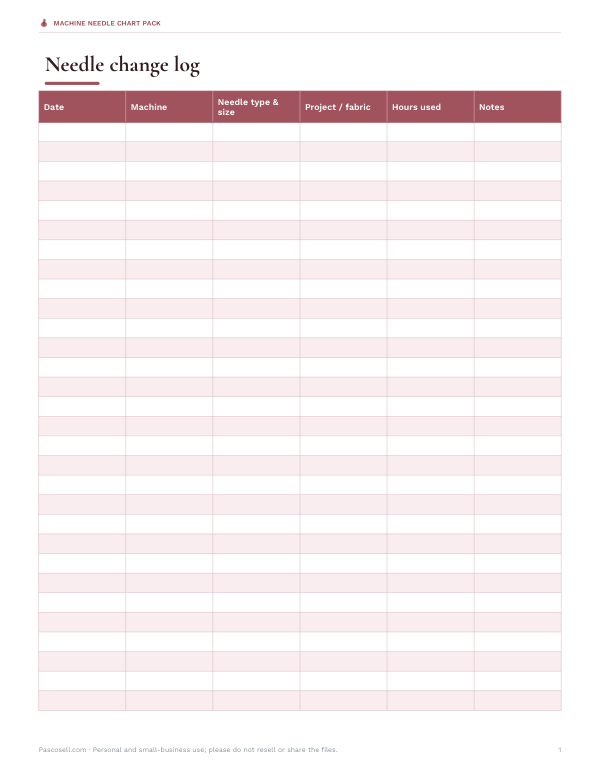 Printable Needle Change Log
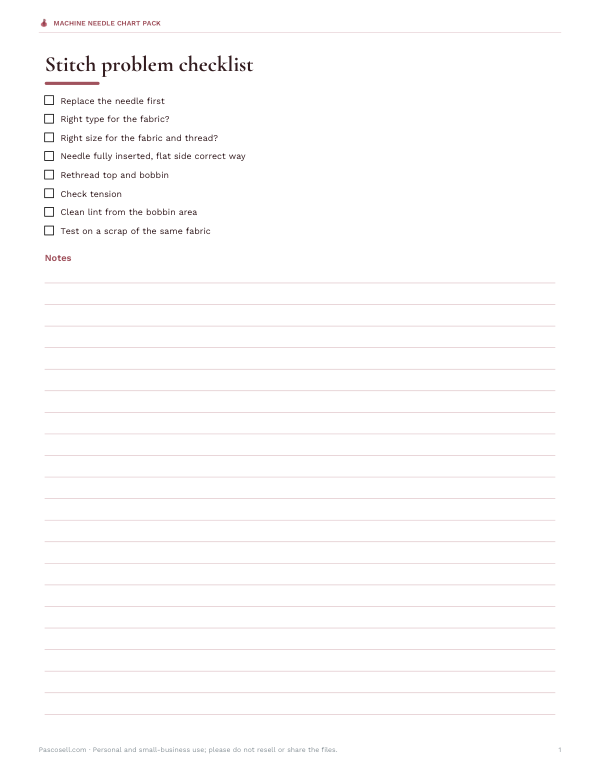 Printable Machine Needle Troubleshooting Chart
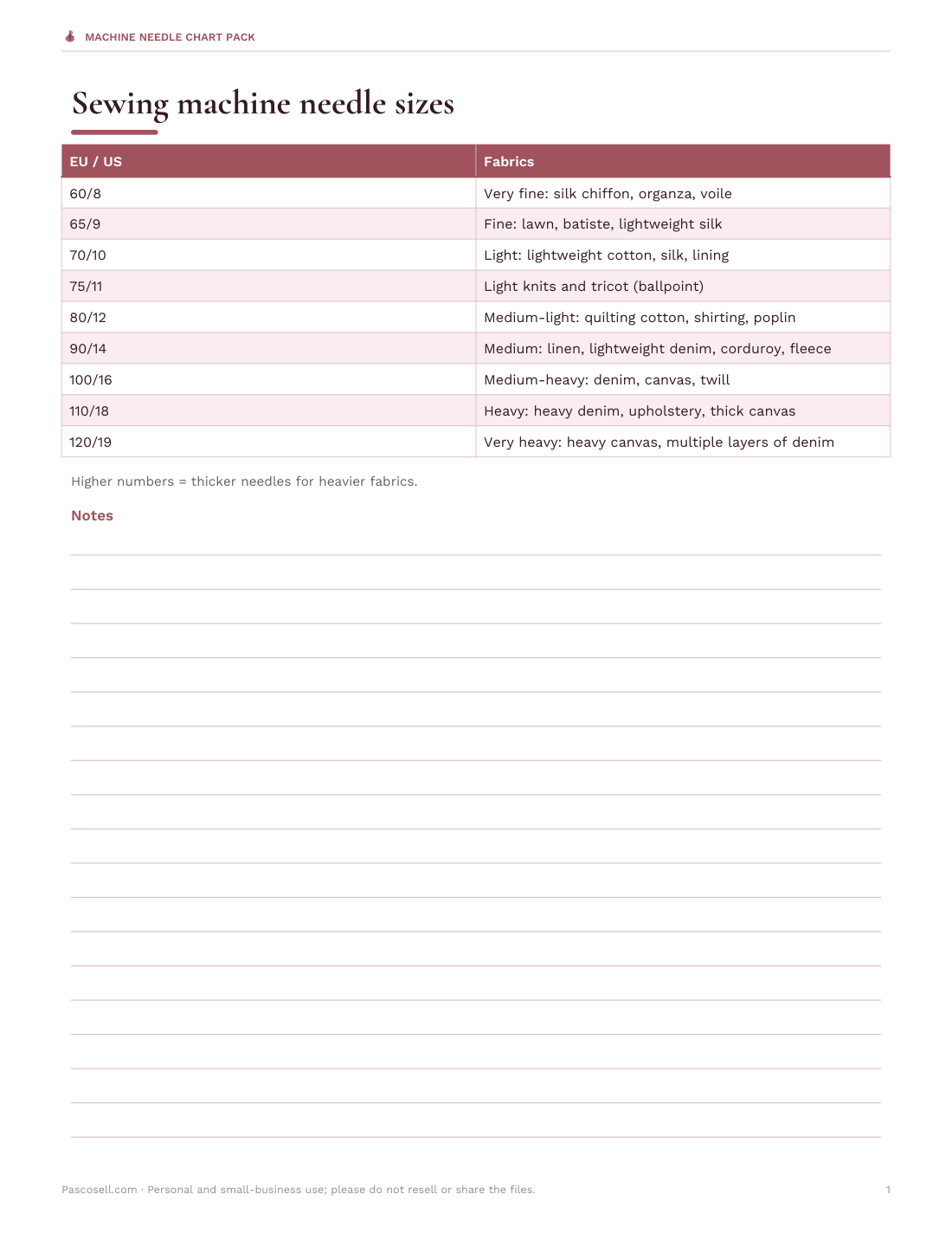
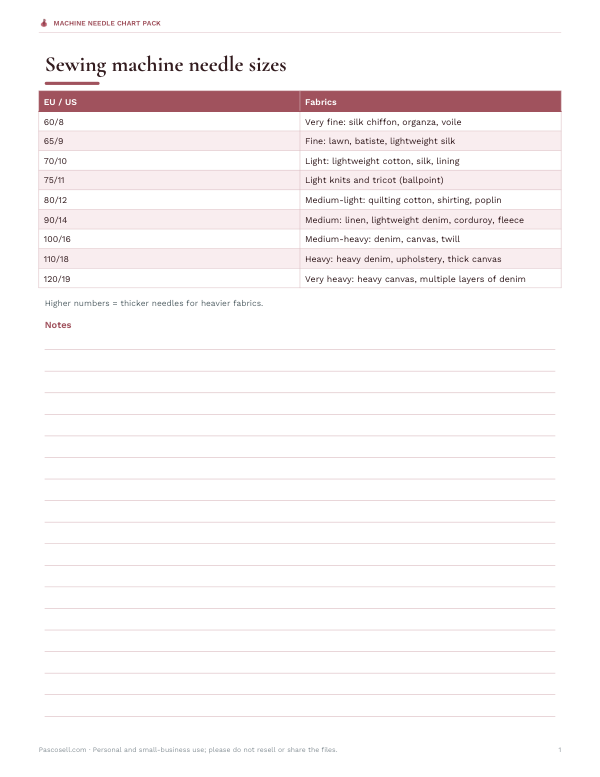
Needle sizes and fabrics
| Size (EU/US) | Fabrics |
|---|---|
| 60/8 | Very fine: silk chiffon, organza, voile |
| 65/9 | Fine: lawn, batiste, lightweight silk |
| 70/10 | Light: lightweight cotton, silk, lining |
| 75/11 | Light knits and tricot (ballpoint) |
| 80/12 | Medium-light: quilting cotton, shirting, poplin |
| 90/14 | Medium: linen, lightweight denim, corduroy, fleece |
| 100/16 | Medium-heavy: denim, canvas, twill |
| 110/18 | Heavy: heavy denim, upholstery, thick canvas |
| 120/19 | Very heavy: heavy canvas, multiple layers of denim |
Sizes are written as two numbers: the European (metric) size is the blade diameter in hundredths of a millimetre (80 = 0.8 mm), and the American size is a separate scale. Higher numbers mean thicker needles for heavier fabrics.
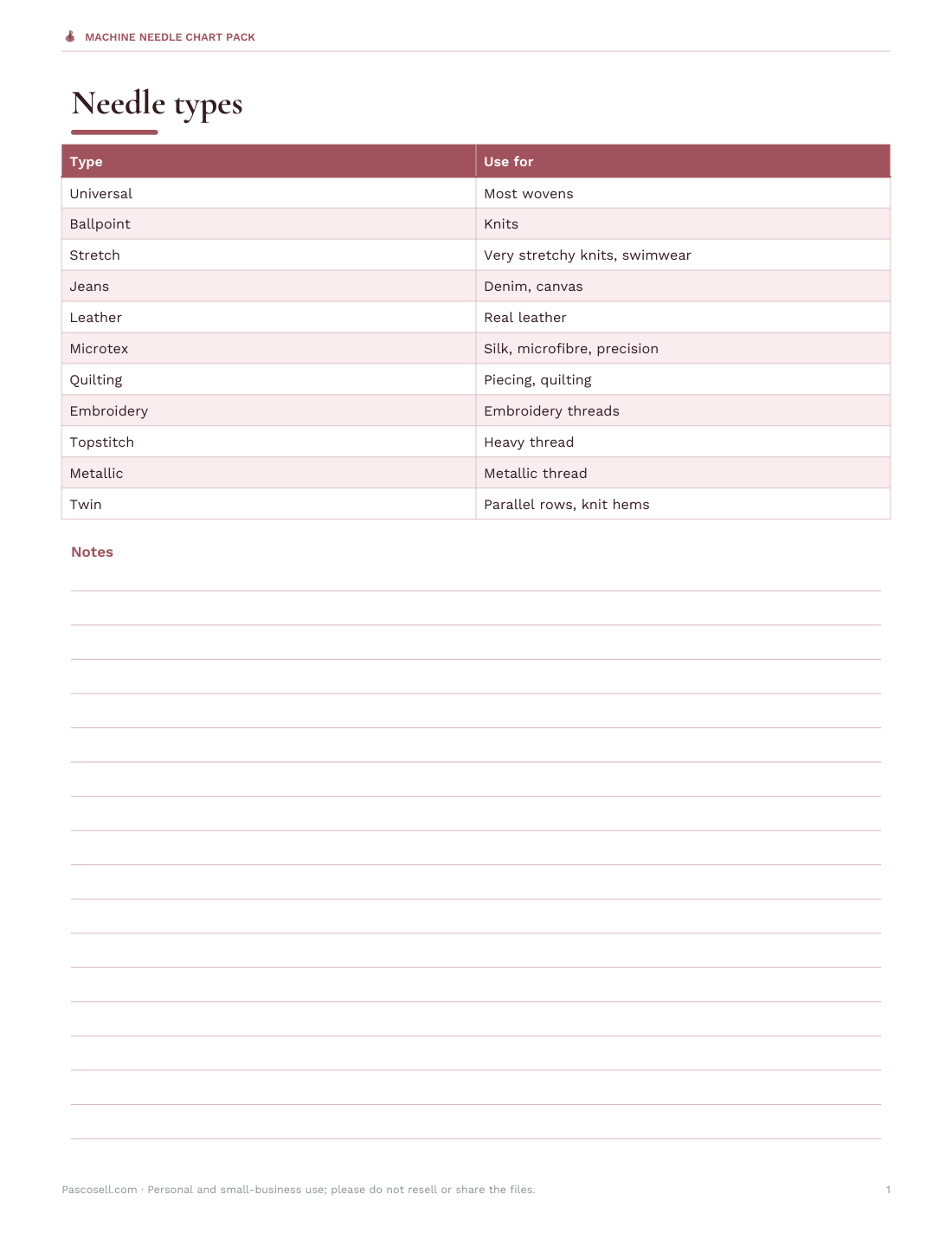
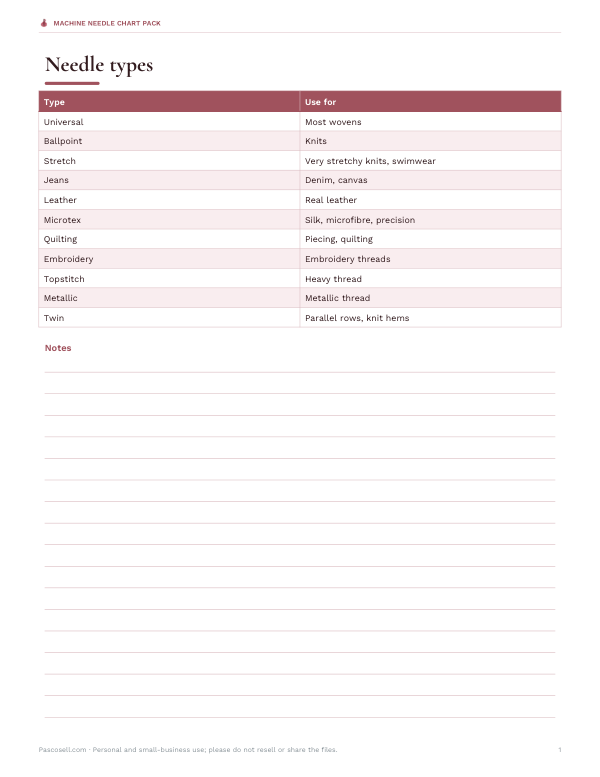
Needle types
| Type | Point / feature | Use for |
|---|---|---|
| Universal | Slightly rounded point | Most woven fabrics and some knits |
| Ballpoint / jersey | Rounded point slips between fibres | Knits: jersey, interlock, sweatshirt |
| Stretch | Special eye and scarf to prevent skipped stitches | Very stretchy knits, swimwear, lycra |
| Jeans / denim | Sharp, strong shaft | Denim, canvas, heavy wovens |
| Leather | Cutting point | Genuine leather and suede (not for faux leather or wovens) |
| Microtex / sharp | Very slim, sharp point | Silk, microfibre, precise topstitching, quilting |
| Quilting | Tapered point | Piecing and machine quilting through layers |
| Embroidery | Larger eye, special scarf | Rayon and polyester embroidery threads |
| Topstitch | Extra-large eye | Heavy topstitching thread, two threads |
| Metallic | Large polished eye | Metallic threads |
| Twin / double | Two needles on one shank | Parallel rows, knit hems (e.g. 4.0/90) |
Thread pairing
| Needle | Thread |
|---|---|
| 60/8 – 70/10 | Fine cotton or polyester (60–100 wt), silk |
| 75/11 – 80/12 | All-purpose polyester or cotton (50 wt) |
| 90/14 | All-purpose, or slightly heavier (40 wt) |
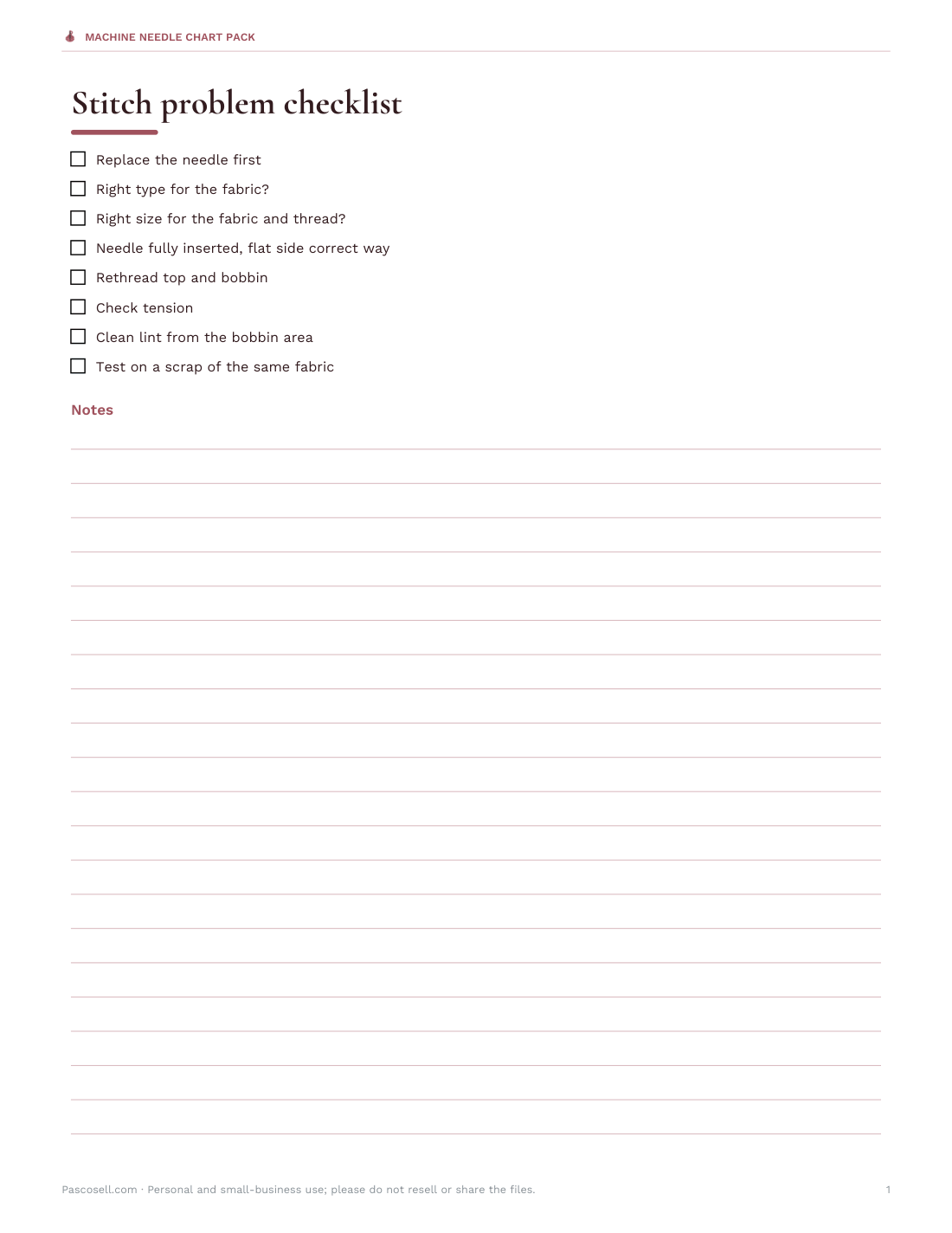
| 100/16 – 110/18 | Heavy-duty or jeans thread (30 wt) |
| Topstitch 90–100 | Topstitching thread (30 wt or heavier) |
The thread should pass freely through the eye and sit in the needle’s front groove. If the thread shreds or loops, try a larger needle or a topstitch/embroidery needle.
When to change your needle
- At the start of every new project — a common habit among sewists.
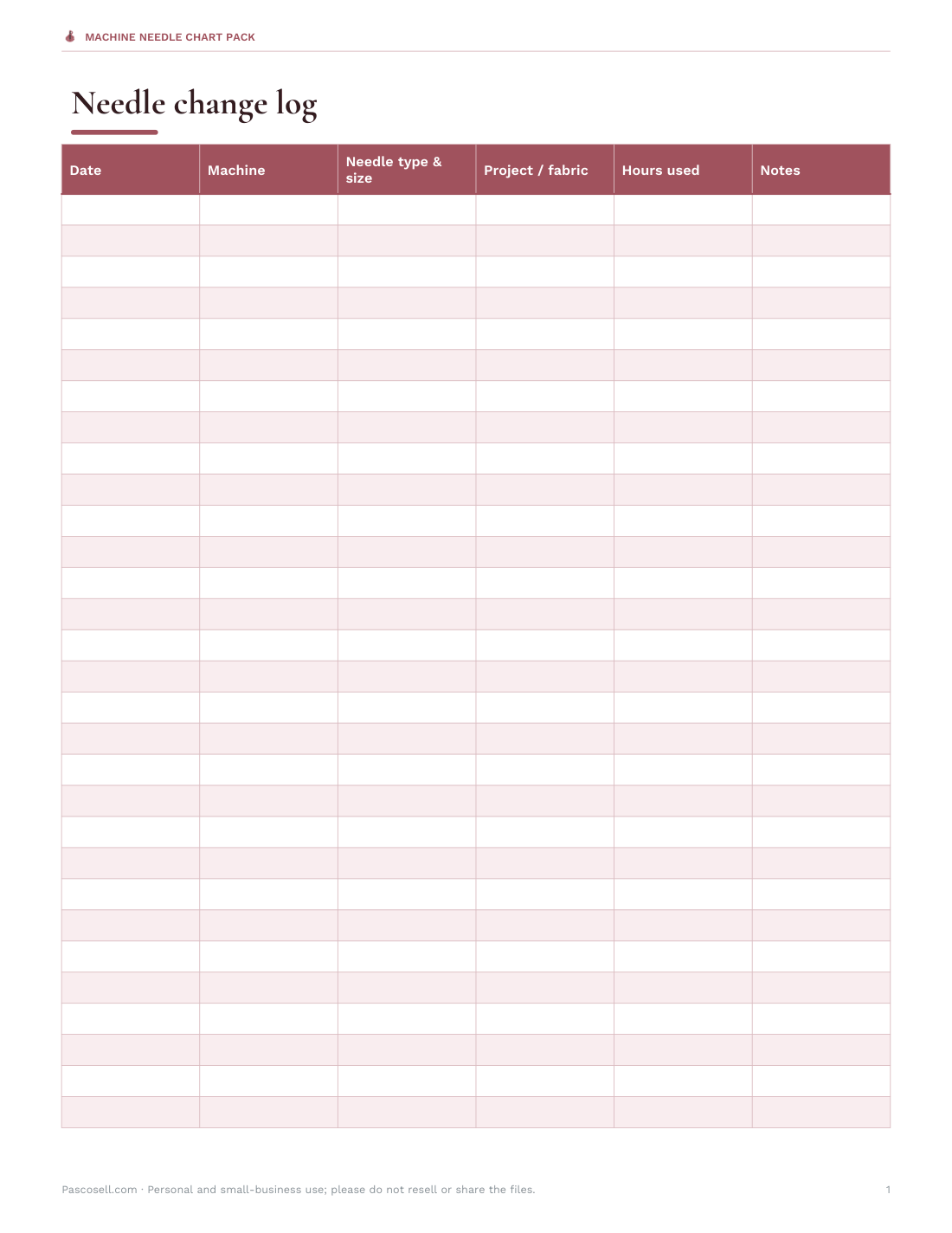
- After about 6–8 hours of sewing, or sooner with dense fabrics.
- Immediately after hitting a pin or if the needle bends.
- When you hear a popping or thudding sound as it enters the fabric.
- When you see skipped stitches, pulled threads or snags.
Worked example: choosing a needle
For a pair of jeans in 12 oz denim, use a jeans needle size 100/16 with all-purpose polyester thread for construction and heavier topstitching thread with a 100/16 topstitch needle for the decorative seams. For a stretchy T-shirt in cotton jersey, switch to a ballpoint 75/11 or 80/12 and a stretch or zigzag stitch. For silk chiffon, use a microtex 60/8 or 65/9 with fine thread and tissue paper under the fabric if it slips.
Troubleshooting
| Problem | Needle-related fix |
|---|---|
| Skipped stitches on knits | Use ballpoint or stretch needle |
| Holes or runs in knits | Ballpoint needle; smaller size |
| Puckering on fine fabrics | Smaller, sharp (microtex) needle |
| Broken needles on denim | Jeans needle, larger size; sew slower over seams |
| Shredding thread | Larger eye: topstitch or embroidery needle |
| Visible holes in fabric | Smaller needle |
| Loud thud each stitch | Blunt or damaged needle — replace |
Formats and printing
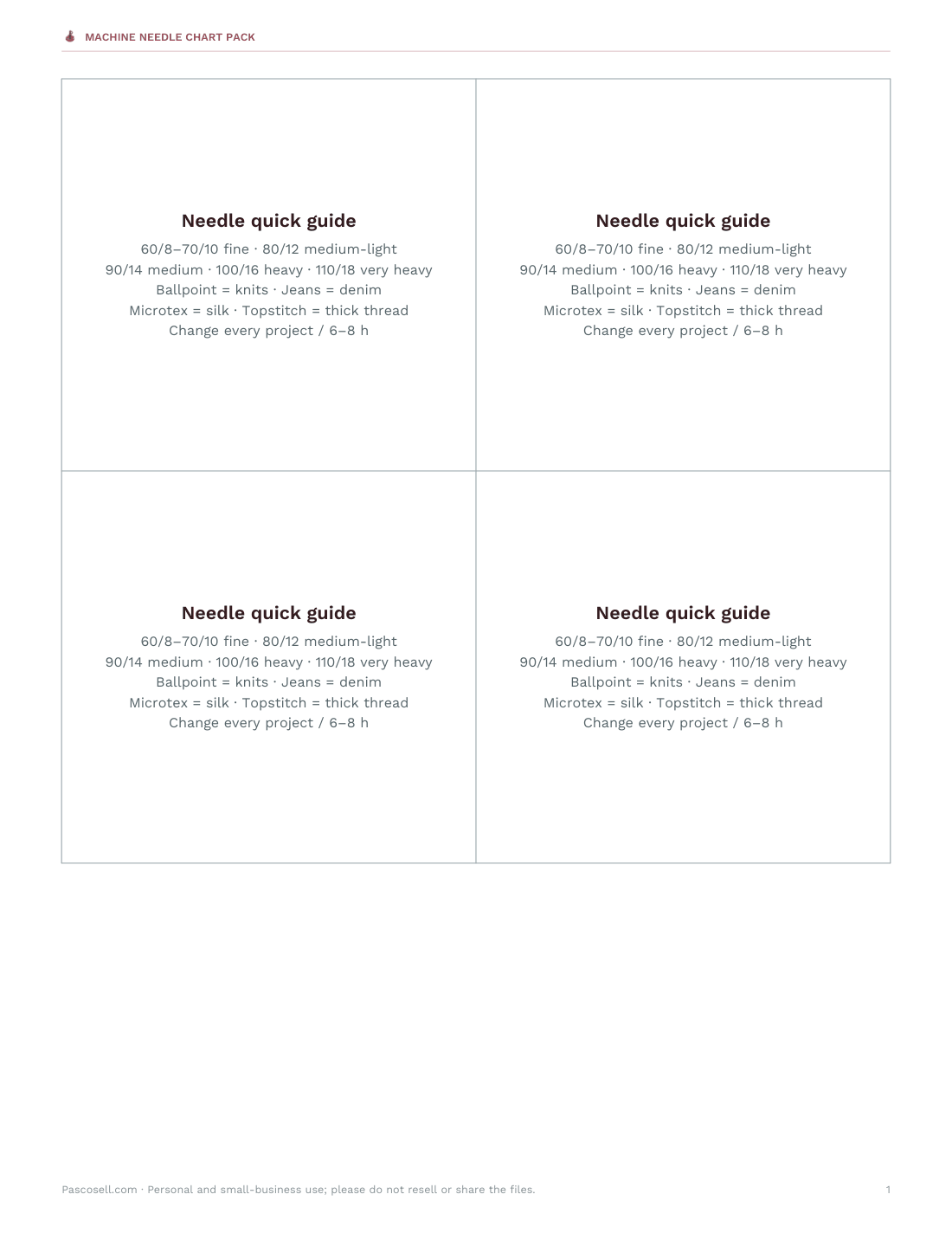
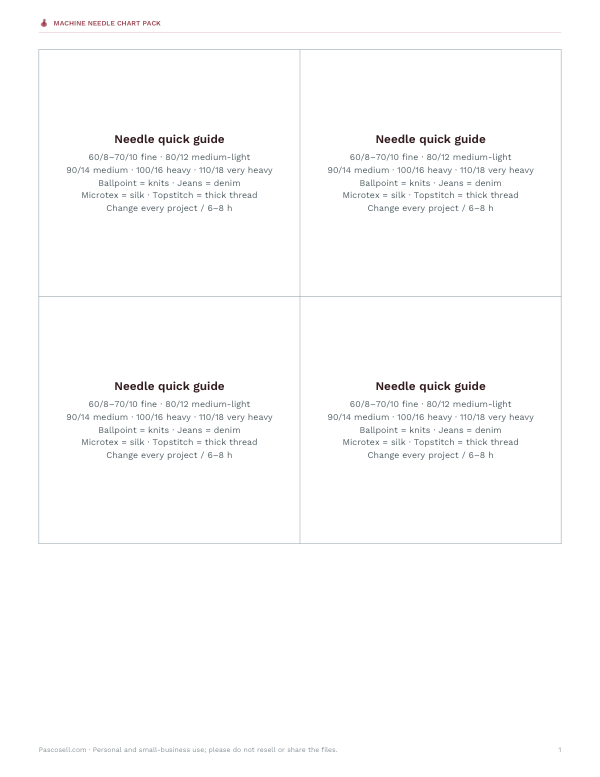
The chart prints on US Letter and A4; the needle change log and project notes are also supplied as editable files. A small card version fits inside a sewing box lid.
AI-assisted content
Charts were drafted with AI assistance and reviewed before publishing. Check your sewing machine manual for recommended needle systems (most home machines use 130/705 H).
Frequently asked questions
What size needle for quilting cotton?
Usually 80/12 universal or quilting.
What needle for denim?
A jeans needle, 90/14 for light denim and 100/16–110/18 for heavier denim.
What needle for knit fabric?
A ballpoint or stretch needle, usually 75/11 or 80/12.
What do the two numbers on a needle mean?
European (metric) and American sizes for the same needle.
How often should I change my sewing machine needle?
Every new project or about every 6–8 hours of sewing.
Is this a subscription?
No, it is a one-time download.